A recent pilot study project run in Italy has involved an innovative system of coils installed beneath the asphalt, which transfer energy to vehicles. The project tested inductive charging technology and aimed at allowing electric vehicles to recharge while driving on designated lanes.
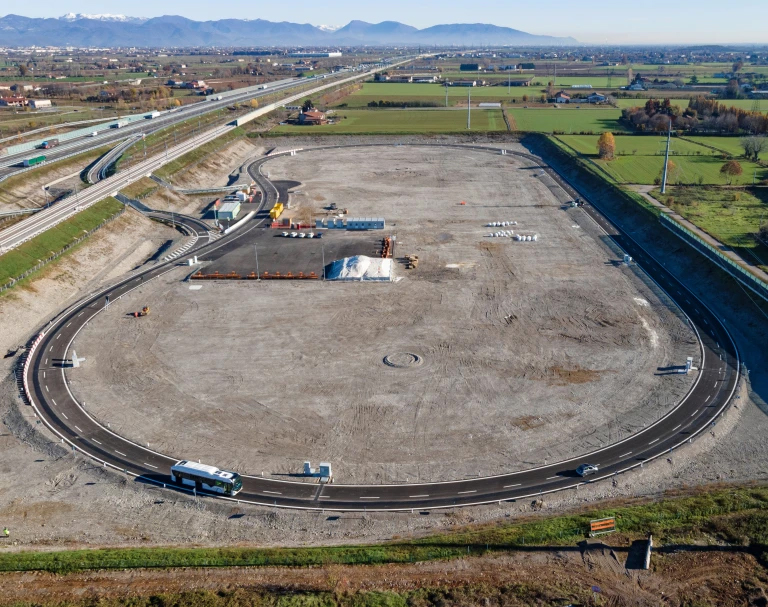
The project was carried out on the “Arena of the Future“ (Arena del Futuro) circuit, a testing ground for EV dynamic induction charging technology built by Stellantis, an international Italian-French-American automotive company with headquarters in the Netherlands.
Partners in the experimental project include Abb, Electreon, Iveco, Iveco Bus, Mapei, Pizzarotti, Politecnico di Milano, Prysmian, TIM, Fiamm Energy Technology, Roma Tre University, University of Parma, Fire Brigade, and the Ministry of Transport.
The “Arena of the Future” circuit surrounds the A35 Brebemi highway, which connects the Brescia, Bergamo, and Milan metropolitan areas in Italy. The site was used as a testing ground for the cutting-edge Dynamic Wireless Power Transfer (DWPT) technology.
DWPT has yielded promising results, bringing us closer to a more efficient way to charge EVs and promote green e-mobility.
Let’s have a look at the technology that lies behind inductive charging and delve deeper into the “Arena of The Future” project.
What is inductive charging?

Inductive charging is a type of wireless power transfer. It is also known as wireless charging or cordless charging. This technology uses electromagnetic induction to deliver electricity to a device.
The device doesn’t have to be perfectly aligned or make electrical contact with a dock or plug.
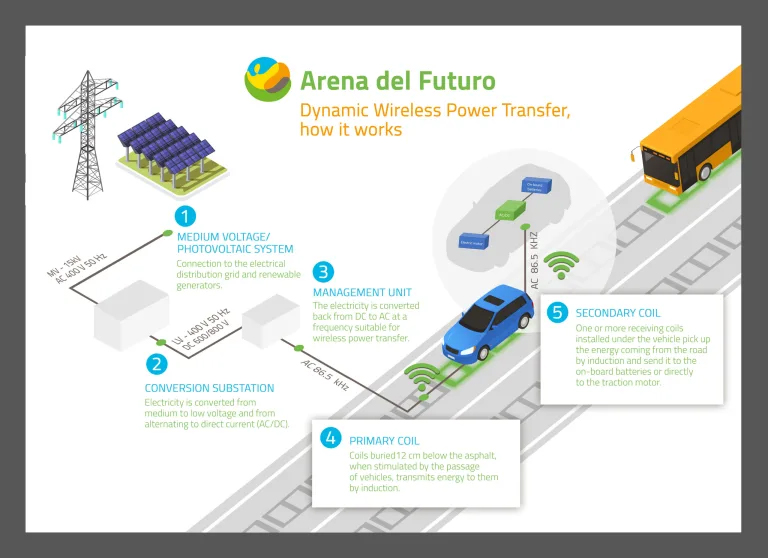
An induction coil in the charging station or pad is first subjected to alternating current.
Because the amplitude of the electric current varies, the magnetic field produced by the moving electric charge also changes in strength.
As a result, the device’s induction coil generates an alternating electric current.
Finally, a battery is charged, or operating power is provided by direct current.
When the inductive charging system employs resonant inductive coupling, a capacitor is added to each induction coil to create two LC circuits with a particular resonance frequency. This allows greater distances between the sender and it allows reaching receiver coils.
The resonance frequency and the frequency of the alternating current match, and the frequency is selected based on the desired peak efficiency distance. Interestingly, recent advancements in this resonant system include the use of a movable transmission coil (i.e., mounted on an elevating platform or arm) and other materials for the receiver coil, such as silver-plated copper or occasionally aluminum, to reduce weight and lower skin effect resistance.
Inductive charging in EVs
Wireless EV charging behaves similarly to induction charging for smartphones, which commonly use the Qi wireless charging standard. A coil receives an electrical current, which creates an electromagnetic field that interacts with an adjacent second coil to produce an equivalent electric current. This current charges the battery of the vehicle.
The automobile sector is now looking at two uses for this scientific idea. These include a wireless charging infrastructure integrated into highways and pad-based wireless charging.
The construction and technical implementation of the “Arena of the Future”, a 1,050-meter-long circuit, powered by 1 MW of electricity, have been completed successfully. As of right now, “Arena of the Future” is ready for EV field testing to verify the viability of the novel technology.
The team of expert technicians are using the Dynamic Wireless Power Transfer (DWPT) system, which is proving to be the most effective in giving immediate answers to the needs of decarbonization and environmental sustainability in the mobility sector.
The inductive charging technology is one of the potential tangible solutions toward the goals stated in the publication “Decarbonizing Transportation, Scientific Evidence and Policy Proposals,” which was recently presented by the experts involved by MIMS (Ministry of Sustainable Infrastructure and Mobility) within the scope of the “Structure for the Green Transition of Mobility and Infrastructure” (STEMI) in light of the current discussion in the European Council of the Fit for 55 Package, presented by the European Commission in the implementation of the Green Deal strategy.
How does Dynamic Wireless Power Transfer (DWPT) work?
This technology allows electric vehicles to recharge themselves thanks to an innovative system of coils placed under the road surface to create a circuit that is slightly more than 1 km long. They have a 1,000-kW total power output from direct current and deliver power directly to cars, trucks, and buses without the need for them to stop at stations to recharge the battery. The technology can be adapted to all vehicles equipped with a special “receiver” that can transfer energy from the road infrastructure directly to the electric motor, extending the range and safeguarding the EV’s battery charge.
What are the benefits and possible applications of EV inductive charging?
Reduced dwell times for charging will improve the passenger’s travel thanks to the system’s easy integration of multiple charging technologies.
This new technology is undoubtedly supported by the new cutting-edge technologies offered by 5G and artificial intelligence, which will implement communication between the vehicle and management systems.
Because of the technology’s dynamic and static induction variables, as well as its versatility, which includes its application not only on roads and highways, but also in other infrastructures such as ports, airports, and parking lots, it has already attracted interest for potential future commercial developments in Italy and abroad.
Conclusions
The transition from the experimental “Arena of the Future” to practical development programs within regional, national, and global strategic infrastructures is going to be quick.
The “Arena of the Future” experiment shows that a BEV fitted to test the system can drive at high speeds without using the energy stored in the battery. Test results indicate that the energy from the asphalt and delivered to the automobile is as efficient as most rapid charging stations.
Additionally, magnetic field strength measurements show that the driver, passengers, and pedestrians are not affected in any way.
The “Arena of the Future” circuit presents a multitude of wonderful benefits, including the potential to reduce energy losses, employ aluminum power distribution cables that are more readily available, use smaller cables than those used for AC distribution, and reduce harmonic pollution.
The adoption of green e-mobility in our daily lives appears to be just one short step away.