

DHT11 Sensor Module with Arduino Temperature and Humidity
The DHT11 is a commonly used temperature and humidity sensor. This post mainly covers its pinout, equivalent, where & how to use and more details about DHT11.
DHT11 Sensor Module with Arduino Temperature and Humidity
The DHT11 is a commonly used temperature and humidity sensor. This post mainly covers its pinout, equivalent, where & how to use and more details about DHT11.
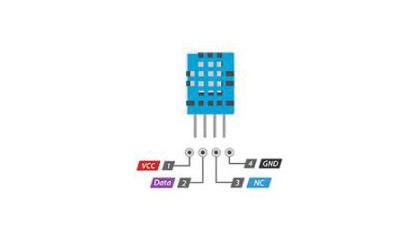
DHT11 Pinout
|
Pin# |
Type |
Parameters |
|
Pin#1 |
Vcc |
Provide 3.3V to 5V at this pin. |
|
Pin#2 |
Data |
This pin provides a digital output. |
|
Pin#3 |
N/C |
Not Connected. |
|
Pin#4 |
Ground |
This pin is used for Ground ( Connected to 0V or GND ). |
The DHT11 Temperature and Humidity Sensor has a temperature and humidity sensor complex with a calibrated digital signal output. It offers high dependability and outstanding long-term stability by employing an innovative digital-signal-acquisition technique as well as temperature and humidity sensing technologies. This sensor consists of a resistive-type humidity measurement component and an NTC temperature measurement component, and it links to a high-performance 8-bit microcontroller, providing great quality, fast response, anti-interference capability, and cost-effectiveness.
Voltage range: 3.5V to 5.5V
0.3mA (measuring) 60uA operating current (standby)
Serial data is output.
0°C to 50°C temperature range
Humidity levels range from 20% to 90%.
Temperature and humidity are both 16-bit resolutions.
1°C and 1 per cent accuracy
Measure temperature and humidity
Local Weather station
Automatic climate control
Environment monitoring
The equivalent for DHT11
DHT22
AM2302
SHT71
The DHT11 is a temperature and humidity sensor that is widely used. The sensor includes a dedicated NTC to detect temperature and an 8-bit microprocessor to output temperature and humidity measurements as serial data. The sensor is factory calibrated as well, making it simple to interface with other microcontrollers.
The sensor can measure temperature from 0°C to 50°C and humidity from 20% to 90% with an accuracy of 1°C and 1%, respectively. So, if you're wanting to measure in this range, this sensor would be a good fit.
The DHT11 sensor is factory calibrated and delivers serial data, making it extremely simple to set up. This sensor's wiring diagram is shown below.
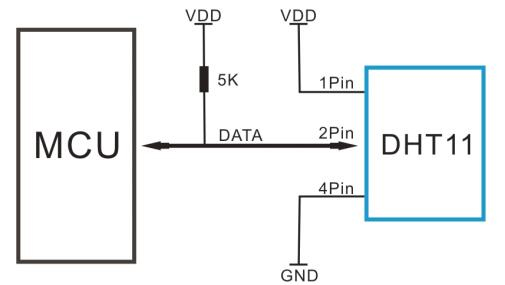
DHT11 Typical Application Circuit
As you can see, the data pin is connected to an MCU I/O pin via a 5K pull-up resistor. This data pin serially outputs the temperature and humidity values. If you want to connect a DHT11 to an Arduino, there are ready-made libraries that will help you get started quickly.
If you are attempting to interface it with another MCU, the datasheet provided below will be useful. The data pin will output 8-bit humidity integer data + 8-bit humidity decimal data +8 bit temperature integer data +8 bit fractional temperature data +8 bit parity bit. To request that the DHT11 module provide these data, the I/O pin must be briefly held low and then raised, as indicated in the timing diagram below.
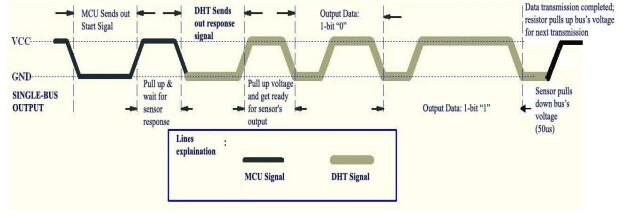
Interfacing DHT11 with MCU
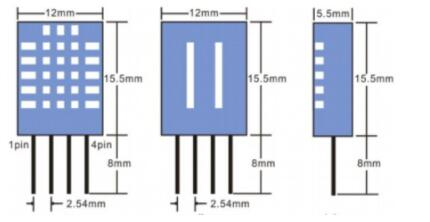
DHT11 Package