Quick Links

DS18B20 Description

The DS18B20 digital thermometer provides 9-bit to 12-bit Celsius temperature measurements and has an alarm function with nonvolatile user-programmable upper and lower trigger points. The DS18B20 communicates over a 1-Wire bus that by definition requires only one data line (and ground) for communication with a central microprocessor. In addition, the DS18B20 can derive power directly from the data line (“parasite power”), eliminating the need for an external power supply.

Each DS18B20 has a unique 64-bit serial code, which allows multiple DS18B20s to function on the same 1-Wire bus. Thus, it is simple to use one microprocessor to control many DS18B20s distributed over a large area. Applications that can benefit from this feature include HVAC environmental controls, temperature monitoring systems inside buildings, equipment, or machinery, and process monitoring and control systems.


DS18B20 CAD Models

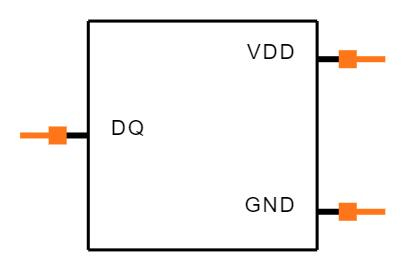
Symbol

Footprint

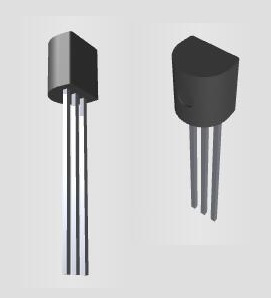
3D Models

DS18B20 Pinout and Configurations


No: Pin Name Description
1 Ground Connect to the ground of the circuit
2 Vcc The powers of the Sensor can be 3.3V or 5V
3 Data This pin gives output the temperature value which can be read using the 1-wire method

DS18B20 Applications

  • Consumer Products

  • Industrial Systems

  • Thermally Sensitive Systems

  • Thermometers

  • Thermostatic Controls

DS18B20 Features

1. Unique 1-Wire® Interface Requires Only One Port Pin for Communication

2.  Reduce Component Count with Integrated Temperature Sensor and EEPROM

  • Measures Temperatures from -55°C to +125°C (-67°F to +257°F)

  • ±0.5°C Accuracy from -10°C to +85°C

  • Programmable Resolution from 9 Bits to 12 Bits

  • No External Components Required

3. Parasitic Power Mode Requires Only 2 Pins for Operation (DQ and GND)

4. Simplifies Distributed Temperature-Sensing Applications with Multidrop Capability

  Each Device Has a Unique 64-Bit Serial Code Stored in On-Board ROM

5. Flexible User-Definable Nonvolatile (NV) Alarm Settings with Alarm Search Command  Identifies  Devices with       Temperatures Outside Programmed Limits

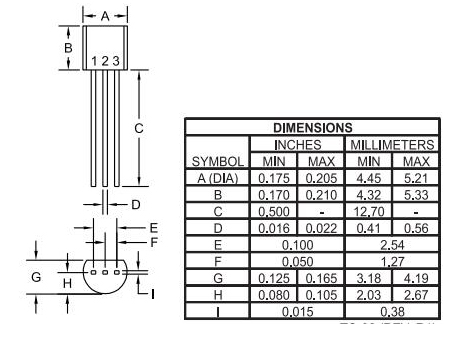
6. Available in 8-Pin SO (150 mils), 8-Pin µSOP, and 3-Pin TO-92 Packages

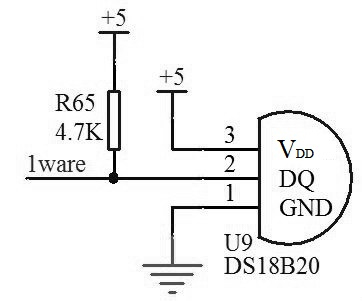
DS18B20 Circuit Schematic

DS18B20 Manufacturer

Maxim Integrated provides ease of design and speeds time to market, through analog integration. The company's analog ICs offer extra features and functionality carefully designed to streamline circuits and simplify the design. Look to Maxim for solutions for consumer electronics, personal computers and peripheralsmobile devices, wireless and fiber communications, test equipment, instrumentationvideo displays, and automotive applications. Maxim’s analog and mixed-signal solutions include data converters, interface circuits, power, RF wireless circuits, clocks and oscillators, microcontrollers (MCUs), operational amplifiers (op-amps), and sensors.

DS18B20 Alternatives

Thermocouple, TMP100, LM75, DHT11, SHT15, LM35DZ, TPA81, D6T

How to use DS18B20?

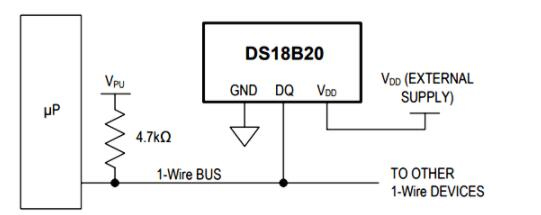
The sensor works with the method of 1-Wire communication. It requires only the data pin connected to the microcontroller with a pull-up resistor and the other two pins are used for power as shown below.

When the bus is not in use, the pull-up resistor keeps the line in a high condition. The sensor's temperature reading will be saved in a 2-byte register inside the sensor. This data can be read using the 1-wire approach, which involves delivering a series of data. To read the values, two types of commands must be sent: one is a ROM command, and the other is a function command. 

If you plan to connect it to an Arduino board, you won't have to worry about any of these issues. You can utilize the built-in functions to access the data and construct the conveniently available library.

Where to use DS18B20?

Maxim integrated's DS18B20 is a 1-wire programmable Temperature sensor. It's commonly used to detect the temperature in harsh settings like chemical solutions, mines, and soil, among other things. The sensor's construction is tough, and it may also be ordered with a waterproof variant, making installation simple. It has a good accuracy of 5°C and can measure a wide range of temperatures from -55°C to +125°C. Each sensor has its own address and only uses one MCU pin to transport data, making it an excellent choice for sensing temperature at various locations without sacrificing too many of your microcontroller's digital pins.

DS18B20 Package

Frequently Asked Questions

FAQ

How does the DS18B20 work?
It works on the principle of direct conversion of temperature into a digital value.
What is the working principle of DS18B20?
The DS18B20 Digital Thermometer provides 9 to 12-bit (configurable) temperature readings which indicate the temperature of the device. It communicates over a 1-Wire bus that by definition requires only one data line (and ground) for communication with a central microprocessor. In addition, it can derive power directly from the data line (“parasite power”), eliminating the need for an external power supply. The core functionality of the DS18B20 is its direct-to-digital temperature sensor. The resolution of the temperature sensor is user-configurable to 9, 10, 11, or 12 bits, corresponding to increments of 0.5°C, 0.25°C, 0.125°C, and 0.0625°C, respectively. The default resolution at power-up is 12-bit.
How connect DS18B20 to Arduino?
First plug the sensor on the breadboard the connect its pins to the Arduino using the jumpers in the following order: pin 1 to GND; pin 2 to any digital pin (pin 2 in our case); pin 3 to +5V or +3.3V, at the end put the pull-up resistor.
Is DS18B20 a thermistor?
A thermistor is a thermal resistor - a resistor that changes its resistance with temperature. ... Thermistors have some benefits over other kinds of temperature sensors such as analog output chips (LM35/TMP36 ) or digital temperature sensor chips (DS18B20) or thermocouples.
What’s DS18B20 power supply range?
3.0V to 5.5V
Tags -
Share this post