Quick Links

TL494 Description

The TL494 device incorporates all the functions required in the construction of a pulse-width-modulation (PWM) control circuit on a single chip. Designed primarily for power-supply control, this device offers the flexibility to tailor the power-supply control circuitry to a specific application.

The TL494 device contains two error amplifiers, an on-chip adjustable oscillator, a dead-time control (DTC) comparator, a pulse-steering control flip-flop, a 5-V, 5%-precision regulator, and output-control circuits.

The error amplifiers exhibit a common-mode voltage range from –0.3 V to VCC – 2 V. The dead-time control comparator has a fixed offset that provides approximately 5% dead time. The on-chip oscillator can be bypassed by terminating RT to the reference output and providing a sawtooth input to CT, or it can drive the common circuits in synchronous multiple-rail power supplies.

The uncommitted output transistors provide either common-emitter or emitter-follower output capability. The TL494 device provides for push-pull or single-ended output operation, which can be selected through the output-control function. The architecture of this device prohibits the possibility of either output being pulsed twice during push-pull operation.

The TL494C device is characterized for operation from 0°C to 70°C. The TL494I device is characterized for operation from –40°C to 85°C.

TL494 Features

  • Complete PWM Power-Control Circuitry

  • Uncommitted Outputs for 200-mA Sink or Source Current

  • Output Control Selects Single-Ended or Push-Pull Operation

  • Internal Circuitry Prohibits Double Pulse at Either Output

  • Variable Dead Time Provides Control Over Total Range

  • Internal Regulator Provides a Stable 5-V Reference Supply With 5Tolerance

  • Circuit Architecture Allows Easy Synchronization

TL494 Pinout and Configurations


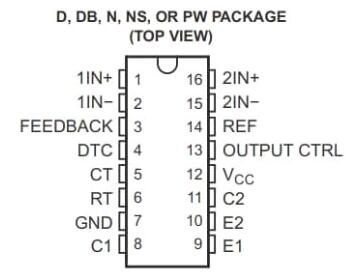
Name NO. Description
1IN+ 1 Noninverting input to error amplifier 1
1IN 2 Inverting input to error amplifier 1
2IN+ 16 Noninverting input to error amplifier 2
2IN- 15 Inverting input to error amplifier 2
C1 8 The collector terminal of BJT output 1
C2 11 The collector terminal of BJT output 2
CT 5 The capacitor terminal used to set the oscillator frequency
DTC 4 Dead-time control comparator input
E1 9 The emitter terminal of BJT output 1
E2 10 The emitter terminal of BJT output 2
FEEDBACK 3 Input pin for feedback
GND 7 Ground
OUTPUT CTRL 13 Selects single-ended/parallel output or push-pull operation
REF 14 The 5-V reference regulator output
RT 6 The resistor terminal used to set the oscillator frequency
VCC 12 Positive Supply

TL494 Application Examples

  • Desktop PCs

  • Microwave Ovens

  • Power Supplies: AC/DC, Isolated, With PFC, > 90 W

  • Server PSUs

  • Solar Micro-Inverters

  • Washing Machines: Low-End and High-End

  • E-Bikes

  • Power Supplies: AC/DC, Isolated, No PFC, < 90 W

  • Power: Telecom/Server AC/DC Supplies: Dual Controller: Analog

  • Smoke Detectors

  • Solar Power Inverters


As we mentioned earlier, the TL494 is a PWM controller circuit. Hence, most of its applications are PWM-based circuits. Here are a few examples:

TL494 Solar Charger

You can easily configure this design by building a 5v/10A switching power supply buck. For this configuration, you can get your output in parallel modes. While you’re at it, connect the output-control pin 13 to the ground.

This application also uses two error amps efficiently (one controls voltage feedback and maintains a constant output while the other controls the maximum current).

TL494 Classic Inverter Circuit

In this application, you can configure the output to work in the push-pull mode. Hence, it would help connect the out-put control pin with the +5 V reference to pin 14. The other nails have the same configuration as the pinout datasheet above.


How to use TL494?

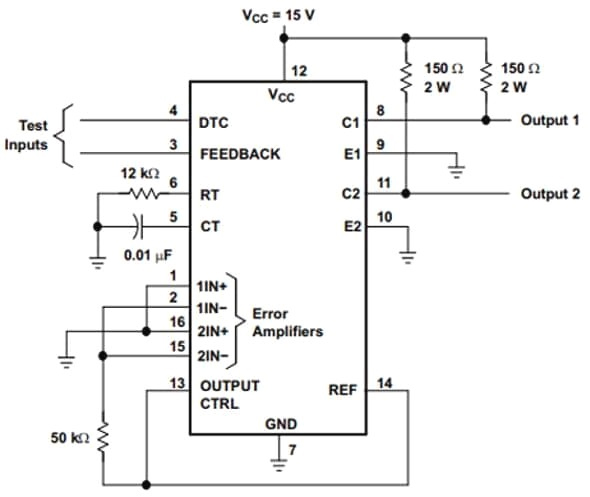
A test circuit from the TL494 datasheet is shown below.

Non-inverting pins are connected to the Ref pin while inverting pins are connected to the ground. Test inputs are given to DTC and FEEDBACK pins. The external capacitor and resistor are connected to pins 5 & 6 to control the oscillator frequency. The error amplifier compares a sample of the 5-V output to the reference and adjusts the PWM to maintain a constant output current


Where to use TL494 ?

The TL494 fixed frequency PWM Controller can be used for DC to DC conversion regardless of buck or boost topology. TL494 can be used to provide a constant current by varying the output voltage to the load. This IC feature an output control circuit, a flip flop, a dead time comparator, two different error amplifiers, a 5V reference voltage, an oscillator, and a PWM comparator.

So if you are looking for an IC to produce PWM signals for controlling a power switch based on the current flowing through the circuit, then this IC might be the right choice for you.


TL494 Package

Package Pins Size
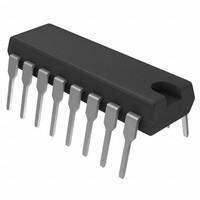
PDIP (N) 16 181 mm² 19.3 x 9.4
SOIC (D) 16 59 mm² 9.9 x 6
SOP (NS) 16 80 mm² 10.2 x 7.8
TSSOP (PW) 16 22 mm² 4.4 x 5

Datasheet PDF

Documents

Download datasheets and manufacturer documentation for   

Frequently Asked Questions

FAQ

What is PWM IC?
The TL494 fixed frequency PWM Controller can be used for DC to DC conversion regardless of buck or boost topology. ... This IC feature an output control circuit, a flip flop, a dead time comparator, two different error amplifiers, a 5V reference voltage, an oscillator, and a PWM comparator.
How does PWM IC work?
As its name suggests, pulse width modulation speed control works by driving the motor with a series of “ON-OFF” pulses and varying the duty cycle, the fraction of time that the output voltage is “ON” compared to when it is “OFF”, of the pulses while keeping the frequency constant.
What is TL494?
TL494 is a PWM controller IC used for power electronics circuits. It comprises on-chip two error amplifiers an oscillator with adjustable frequency feature, an output flip-flop having pulse steering control, and an output control circuit with feedback.
What is the use of TL494?
TL494 is a PWM controller IC used for power electronics circuits. It comprises on-chip two error amplifiers an oscillator with adjustable frequency feature, an output flip-flop having pulse steering control, and an output control circuit with feedback.
Is PWM AC or DC?
It's neither, really. AC means that the voltage/current changes polarity. A PWM signal typically is a logic signal that turns on and off. So, a PWM signal is more accurately described as a pulsed DC signal.
Tags -
Share this post