Digital twins not only provide engineers and designers with real–time data of how a physical asset performs, but they also offer time and cost advantages during the test and developmental stages of both new and existing products. But what if augmented reality (AR) and virtual reality (VR) technologies could further extend those benefits?
“Companies can initially use digital twins to save money simply by improving situational awareness,” according to research firm Gartner. “For example, digital twins can help companies to recognize equipment failures before they stall production, allowing repairs to be made early or at less cost. Companies can then save even more money when they further automate their business response to such changing conditions.”
Implementing AR/VR technologies in the digital–twin design and management process, however, can not only improve productivity within many industries — most notably aerospace, automotive, and industrial — it can also enhance experimentation and predictive analysis of existing products, with the potential of reducing downtime and incurred costs.

One such company, TechViz, is creating AR/VR software to aid 3D model visualization. The VR software editor has built a software platform that “instantaneously displays in 1:1 scale any CAD model on any type of virtual reality system.” Essentially operating as a driver for a VR system, TechViz allows engineers to fully immerse themselves in virtual reality to interact with native 3D data in real time.
But if a physical asset already exists, why the need to create a digital version of that asset within an AR/VR environment? TechViz explains that the benefits are not only quantitative in nature but also qualitative.
“Virtual reality can adapt to many use cases and better process in your company, but what is the return on investment (ROI) of using VR?” said TechViz in a blog post. “Many benefits are drawn from VR in engineering, like saving time and money at different stages of product development. But the gains are not just quantitative but also qualitative, like improving process and product quality, fostering innovation mindset, and refining the worker’s skills.”
Take, for example, a manufacturer in need of testing a critical piece of equipment used to build a product. It’s possible to test and troubleshoot physical assets; however, it’s time–consuming and risks negatively impacting manufacturing operations if a piece of equipment must be shut down entirely.
If the manufacturer were to create an exact digital twin of said equipment, however, and utilize AR/VR technologies to allow engineers to test and manipulate the equipment within a digital space, reduced downtime, improved costs, and workload productivity then become a reality.
“Many companies rely on CAD models to convey design ideas, but it is a limited tool,” said TechViz. “Running a project review in virtual reality enables you to display and interact with your 3D data in scale 1:1, which will be cheaper than a physical prototype and more intuitive than looking at a CAD software on a computer screen.”
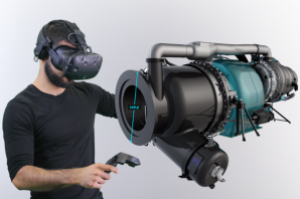
Another company, Weviz, is also exemplifying the benefits of AR/VR for digital asset design and management. The 3D real–time collaborative visualization software for VR provides a basis for virtual collaboration, enabling engineering teams to directly upload their CAD models and 3D files, the ability to edit those models in real time, scale 1:1, and collaborate with its multi–user mode.
“Virtual reality gives you the opportunity to see at real scale your future manufacturing lines of production as if they were real,” according to Weviz.
It’s important to note, however, that AR/VR implementation with digital–twin technology does present its own unique challenges. While AR/VR can potentially enhance digital twins, the process alone is data–intensive. For this reason, enterprises are often the ones to implement AR/VR technologies into their digital–twin operations. The cost–effectiveness of some AR/VR devices, however, certainly opens the door for small to mid–sized businesses to realize the potential of this ever–growing technology.