Mersen has developed novel overcurrent protection technologies for renewable energy storage systems with their ABAT and GBAT fuse series. These fuse series comprise the product lines dedicated to 1000V to 1500VDC applications.
In 2015, 196 countries agreed to the Paris Climate Accords to limit global warming to a 2°C temperature rise. Renewable energy sources must replace fossil energy sources to achieve this goal. Battery Storage or Energy Storage Systems (ESS) store intermittent energy produced by renewables such as solar or wind power generators and then distribute it back into the grid.
Game-changer for the Smart Grid
Energy Storage Systems provides utilities with the critical flexibility for incorporating renewable energy into the modern smart grid. As for battery technology changes worldwide, ESS integrators continue to design systems with more power capacity levels. Electrical energy storage systems often have capacities of several hundred MWh. The global energy storage market continues to prove resilient to the impacts of COVID-19 and supply constraints for Li-ion batteries. It will enter a prolonged period of growth, with annual installations reaching more than 30 GW by 2030 – up 250% from 2021 levels – according to the latest report from the Clean Energy Technology service at IHS Markit. This places extreme demands on protection systems, not to mention challenging load profiles with constantly fluctuating charge and discharge cycles.

“As a result of climate change, we will need more and more storage systems to store all the renewable energy being generated. In addition, a standard is needed to protect these new electrical systems”, explains Mersen expert Dr. Philippe Roussel.
To protect these electrical energy storage systems, Mersen Electrical Power introduces the ABAT and GBAT fuse product series. These products supplement Mersen’s DC overcurrent protection portfolio of products designed to meet the various needs of customers and applications of the energy storage systems. All products conform to the new IEC 60269-7 standard supplementary requirement for fuse links for the protection of batteries and battery systems.
The ABAT15A is mainly dedicated to integrated suppliers that provide the battery rack. A battery rack is an assembly of battery modules in series into one rack or string of batteries controlled by a Battery Management System (BMS). The fuse is installed to protect the battery and contactors from short circuits located inside the BMS. The fuse current rating varies from 100 to 500A.
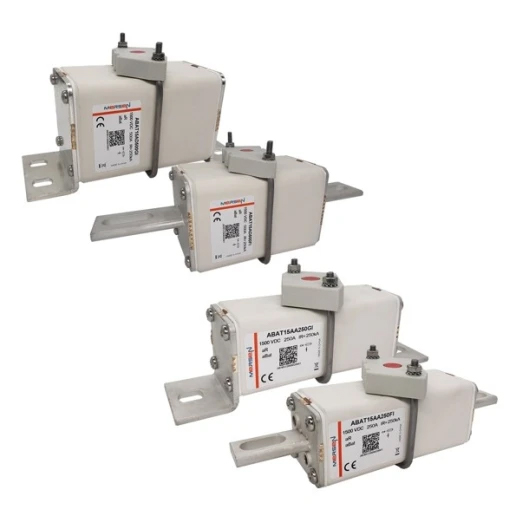
The ABAT15C and ABAT15D were designed for system integrators and Power Conditioning Systems (PCS) manufacturers. By selecting the number of battery racks in parallel in one system, the system integrators can define the power input and output according to their customers’ needs. The racks can be installed in sections, which can then be installed in a container. Multiple racks can also be installed directly into a container. The PCS manufacturer provides the inverter necessary to connect the complete battery system to the grid by converting the power from DC to AC. Depending on the system integrators, they are able or not, to provide both the complete set of battery systems and the PCS. As multiple battery systems are installed, the power output is higher than a rack, resulting in a fuse rating from 500 to 1600A.
All ABAT fuses have been tested with short circuit currents up to 250 kA.
Energy Storage Solutions for Small and Large Overcurrents
The fuses in the GBAT series are designed for use in battery containers and inverters. These fuses provide both short circuit and overload protection, covering overcurrents of lesser magnitude and DC fault currents up to 150 kA, at time constants (L/R) of 1 to 3 milliseconds.
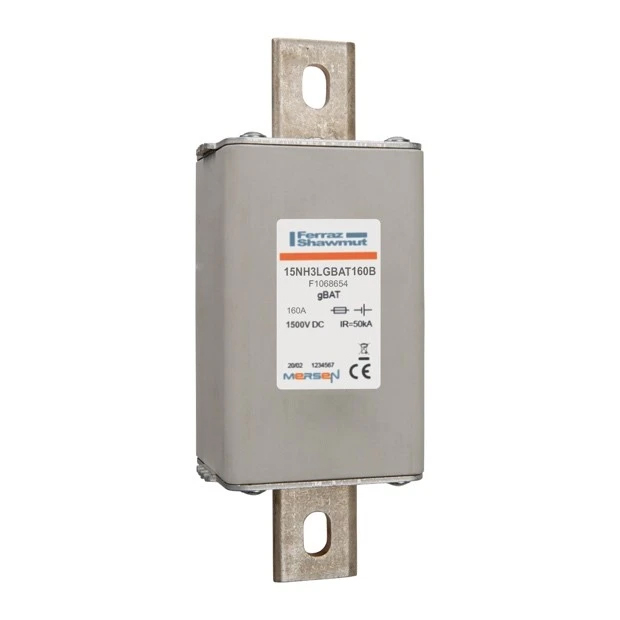
GBAT fuses come in two nominal voltages: fuses for system voltages up to 1000 V DC in sizes NH1 and NH2 (up to 50 kA) and 1500 V DC fuses in sizes up to NH3XL (up to 150 kA). All GBAT fuses are available with either screw-on blades for direct mounting or with plain blades.
Renewable Energy Applications
As a global expert in electrical energy, Mersen offers a broad portfolio of products for use in renewable energy applications. They include an extensive line of electrical protection equipment for photovoltaic solar systems.